Pacific Transit System Driving the Future – Vision 2026-2029
Pacific Transit System Reports Strong Growth, Service Enhancements, and Strategic Investments
Pacific County, WA — Pacific Transit’s future looks bright, and the numbers back it up. Over the past 18 months, investments in new technology, enhanced route planning, and a dedicated Operations team have driven meaningful improvements, benefiting both riders and the broader Pacific County community.
Ridership continues to rebound since the sharp downturn caused by the Covid-19 pandemic. Software installed in 2025 is giving Pacific Transit operations access to data on a level never seen before. Previously, our data had significant gaps, and the accuracy was only as reliable as our connectivity. Ridership was recorded manually using paper cards, requiring hours of staff time to compile and analyze. Drivers counted passengers as they boarded, and totals were reported by route run rather than by individual stop—limiting the level of detail available. With the implementation of advanced industry tools—including ArcGIS, computer-aided dispatch, and business intelligence software—PTS now has greater visibility into system performance and a stronger ability to meet daily operational goals.
Pacific Transit finished 2025 on a strong note and is off to a positive start in 2026. Ridership is expected to surpass previous highs in the coming years. Today, our new Swiftly software automatically captures when and where passengers board, providing accurate, real-time data at the system level, the route level, and the stop level. This allows Pacific Transit to better understand rider patterns and make more informed service decisions. This will ensure that we address the highest need areas with more frequency and the connectivity to provide transit services throughout Pacific County.
“We now have the ability to see exactly how our system is performing at a much more detailed level,” said Joseph Zurfluh, PTS Operations Manager, “That insight allows us to be more responsive and strategic in how we serve our community.”
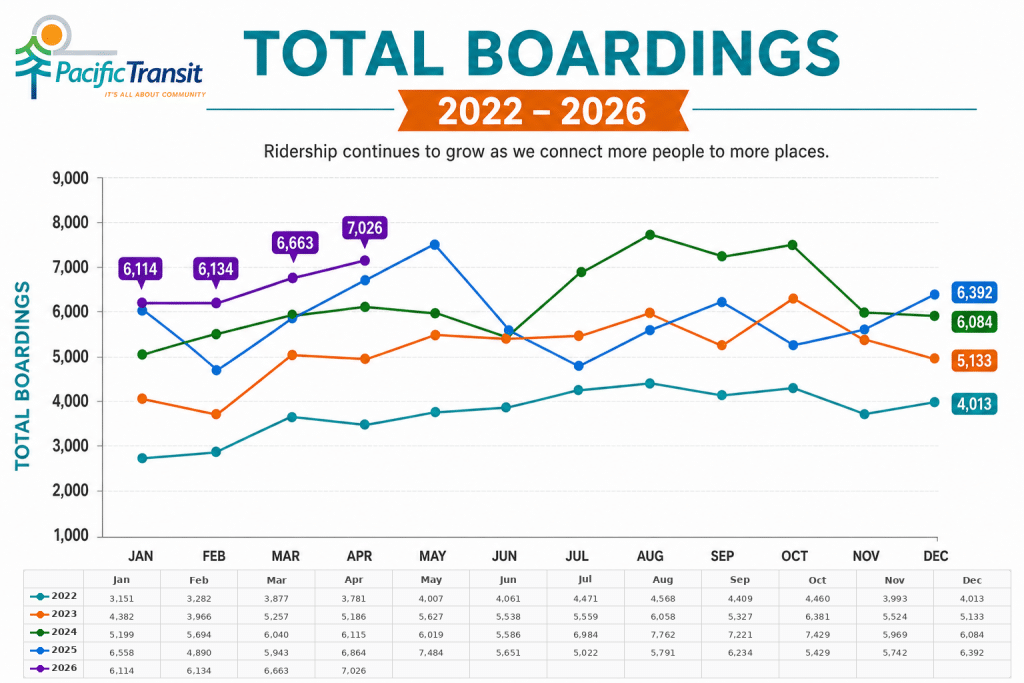
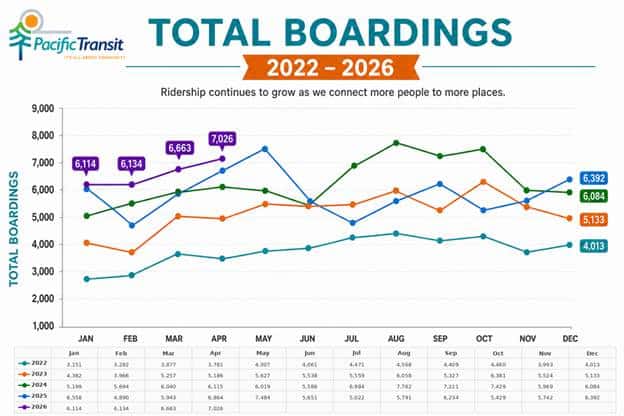
While these innovative transitions in 2025 presented some challenges, including temporary system outages, ridership has continued to trend upward since its low point in 2022. This steady growth is reflected in the annual ridership data on the next page.
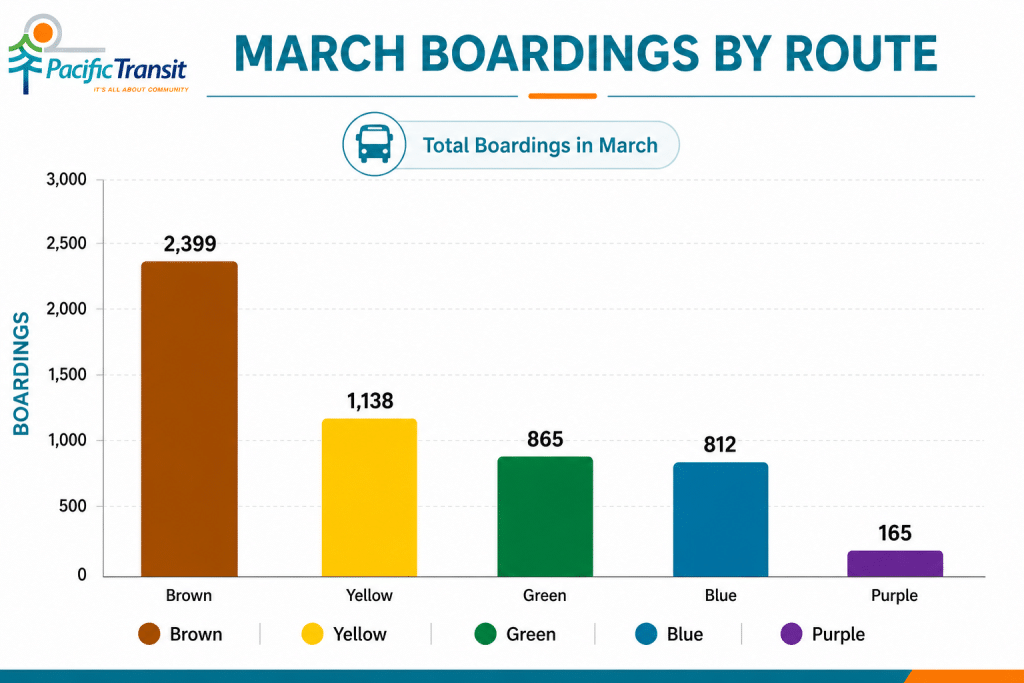
It is critical that Pacific Transit’s management team remains focused on effective resource allocation and utilization. A more detailed analysis of route performance provides deeper insight into service demand and operational efficiency across the system.
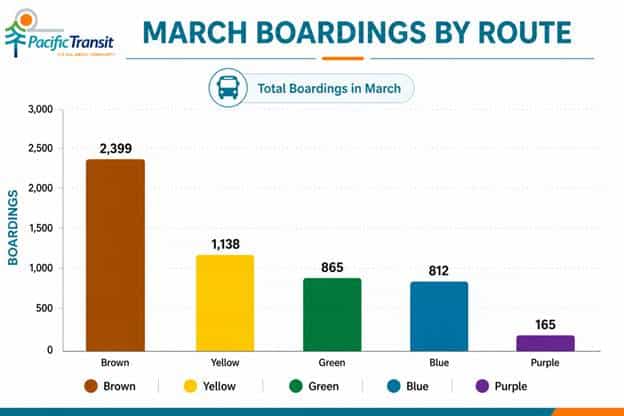
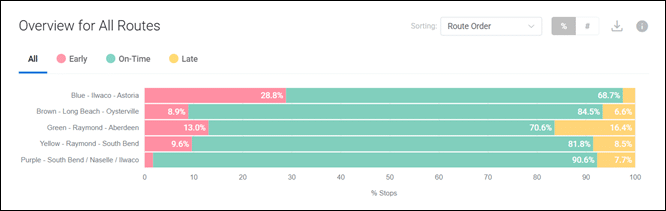
Effective management and monitoring of route performance are essential to delivering high-quality service. Using on-time performance tools within our software, we can analyze data at a detailed level to identify opportunities for improvement and enhance overall system performance. This data-driven approach ensures riders can depend on a resilient, reliable, and sustainable transit system across the county.
Essential Service, Every Day
Pacific Transit’s ADA Paratransit and general Dial-a-Ride (DAR) services remain a cornerstone of its operations, providing critical transportation for medical appointments, grocery trips, and other essential needs. Ridership has nearly returned to pre-pandemic levels, with 12,316 riders served in 2025. Although a decrease from our highest year of ridership (13,928 riders in 2016), we accomplished this by delivering more rides across more miles than at any other time in PTS history. Demand for life essential services is resulting in an increase in ADA paratransit and Dial-a-Ride services. Pacific Transit is committed to finding options that increase opportunities for those in need of critical medical transportation. We are dedicating ourselves to increasing capacity for those in most need throughout our community.
“I’m truly impressed with Pacific Transit,” said Johnny Green, who uses Pacific Transit’s Dial A Ride service. “They’ve been consistently on time getting me to and from my critical dialysis treatments, which means a lot. The customer service is outstanding—professional, caring, and reliable. Definitely a class act.”
While getting riders to much-needed medical appointments is a driving factor in Dial-a-Ride service, Pacific Transit remains committed to equally important trips to the grocery store, senior center, and “Bob’s house” for a visit.
“I’m proud of the growth of our Dial-A-Ride service; as a former medical transporter and the daughter of someone who relies on public transportation, I understand how essential these services are,” said Operations Supervisor Melissa Popleik. “I remain deeply committed to supporting our riders and strengthening our community.”
It’s an example of how Pacific Transit is responding to the needs of riders and ensuring the system will continue to meet growing demands into the future.
“Maintaining reliable transit service is essential to our community’s economy and quality of life,” said Rebecca Towner, Director of Finance & HR, “This strategy allows us to stabilize operations while continuing to pursue long-term funding solutions.”
Optimizing the System to Meet Ridership Demand
As more and more riders climb aboard, Pacific Transit continues to improve how it delivers service. Riders asked for more frequent service. New bus schedules launching April 20 will increase frequency through the Orange Express in Raymond and the Red Express in Long Beach, supplementing the existing Yellow Line in Raymond and Brown Line in Long Beach.
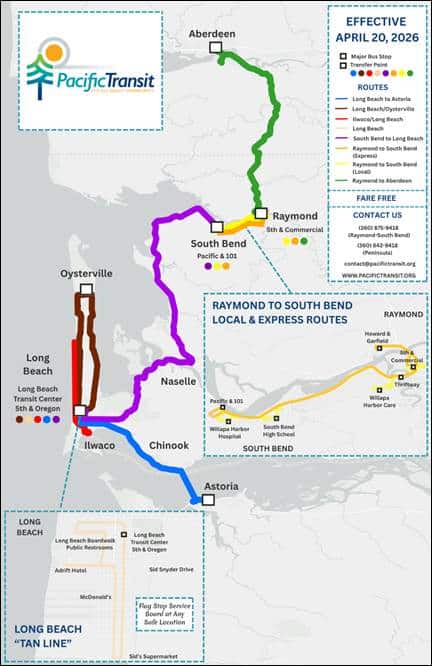
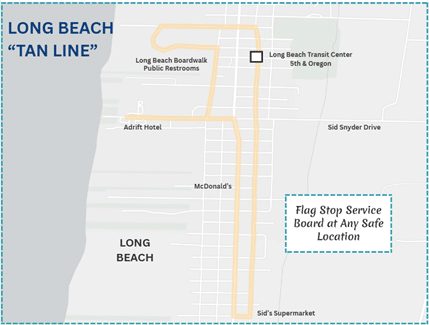
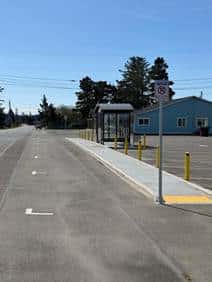
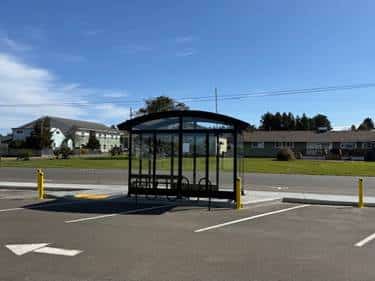
A new transit center in downtown Long Beach makes it all possible. Pacific Transit recently built a bus shelter at Fifth and Oregon in Long Beach. This new facility will serve as a transfer center for passengers going to and from Long Beach, Oysterville/Ocean Park, Ilwaco, Astoria, and South Bend. Additionally, we have created a seasonal route specifically for tourism and community events in the Long Beach downtown corridor, called the Tan Line.
“Establishing a route dedicated to supporting our tourism industry will create stronger economic opportunities for local businesses as well as making connections to Astoria for our residents,” stated Mayor Sue Svendsen of Long Beach.
North County Enhancements
The route improvements in north Pacific County consist of a new Orange Line making its debut on April 20, that will decrease the trip time between Raymond and South Bend, following closely in the tire marks of the former Shopper Shuttle. The popular route will resume taking riders to common retail destinations in the Raymond-South Bend area, making the loop in about 40 minutes. The Yellow Line improvements include additional stops to help provide access to more demographically concentrated residential and service areas.
“Expanding services into these neglected neighborhoods provides new opportunities for our citizens that were previously not available,” said Mike Williams, Planning, Communications & Grants Manager.
The Purple Line from South Bend to South County will continue, but with modifications to make the trip more efficient. Riders wanting service to or from Bay Center or Naselle will be asked to call ahead. PTS made the decision to shift Bay Center on the Purple Route to a stop-by-request service after reviewing ridership data and recognizing that demand in that area did not support a fixed stop. “This change allows us to better allocate service where it’s most needed, while still maintaining access for riders in Bay Center,” stated Joseph Zurfluh, Operations Manager, “It also helps us align the Purple Route with the connection structure of our Blue, Brown, Red, and Tan routes, improving overall system efficiency and reliability.”
The Green Line will continue to operate between Raymond and Aberdeen with consistent reliability.
“Service along this route has been consistent and dependable, and we’re pleased with how it’s performing,” shared Larry Schmid, PTS Bus Operator, “Ridership is up, everyone seems to be happy, and we believe the route is meeting the riders’ needs.”
Investing in Infrastructure and Fleet
Pacific Transit has adopted a comprehensive fleet replacement schedule, which focuses on the useful lifetime of our equipment, our facilities, and our assets. In 2025, we incorporated eight new vehicles into service and are on pace to replace our entire aging fleet by 2032. More new vehicles will hit the road over the next few years as Pacific Transit’s new vehicle replacement schedule prevents buses from working past their useful life.
John Hayes, Fleet & Facilities Manager stated, “As new equipment is added to our fleet, it provides a more comfortable experience for our riders and a reduction in operational and maintenance costs.”
Another important effort underway is the replacement of the North County Operations & Maintenance Facility. PTS solicited expertise from the commercial construction industry to ascertain the viability of the current facility; through this process it became apparent that the facility had exceeded its useful lifetime and would cost more to repair than to replace. Therefore, we are now undertaking a private-public partnership with local community members to construct a new North County Operations & Maintenance Facility. The facility on Seventh Street will include office space for all supervisors, modern amenities to improve working conditions for staff and drivers, bus washing facilities and infrastructure to support future technologies, including electric vehicle charging.
Mayor Dee Roberts of Raymond shared, “Having a new Operations & Maintenance Facility will ensure that the future of our transit system is evolving to meet the needs of our community.”
The North County Operations & Maintenance Facility will house staff and buses, but the main North County transit center at Fifth Street and Commercial will continue to be the Raymond passenger hub. Buses will not pick up passengers at the new facility on Seventh Street.
Pacific Transit System remains focused on delivering safe, reliable, and accessible transportation while adapting to the evolving needs of the community. With continued investment in technology, infrastructure, and service improvements, PTS is well-positioned to support economic activity, tourism, and regional connectivity for years to come.
Financial Strategy Supports Long-Term Stability
Pacific Transit System is implementing a proactive financial strategy to ensure long-term stability and continuity of service. The financial planning that was previously in place was woefully inadequate and as a result would have led to a significant reduction in service and jeopardized the overall PTS system. In response, the current administrative team has identified approximately $31 million in potential grant opportunities to strengthen the agency’s financial position. While these grant funds are critical to long-term sustainability, they are not expected to be available in time to fully support near-term needs. As a result, PTS is pursuing additional financing options to bridge this gap and maintain current service levels.
Key strategies under consideration include:
- Evaluating general Dial-a-Ride fare structures
- Exploring alternative fuel options to reduce long-term operating costs
- Adjusting service levels, including modified weekend hours
- Implementing cost-saving measures such as outsourcing fueling services in place of significant capital investments
- Leveraging existing sales tax revenues—supported in large part by tourism—to responsibly incur short-term debt service
This financing approach will not result in new or increased taxes. Debt repayment will be funded through existing sales tax revenues already collected across Pacific County, which is adequate to meet these financial responsibilities.
Maintaining and enhancing transit services supports local economic development, growth and tourism, and regional connectivity for essential services. Increased access to transportation contributes to stronger communities and generates broader benefits through increased sales tax revenue, which benefits not only Pacific Transit System, but the entire Pacific County economy.
“Providing community-based systems such as PTS increases opportunities for local residents and visitors to our area. Pacific County leadership, in collaboration with Pacific Transit, is setting the stage for a new strategic direction that integrates innovation and imagination,” stated Joe Clark, Interim Executive Director of Pacific Transit.